EP.02: The Growth Infrastructure
In this episode, we sit down with Bryan Kim, Partner at a16z, to dig into what growth actually costs when it goes wrong, and what it takes to build the infrastructure to get it right. Bryan spent over five years at a16z backing some of the most ambitious consumer businesses of this era, including ElevenLabs, Function Health, Mirage, Partiful. Before that, he built and ran growth at Snap (from 100 people and zero revenue to 4,000 people and $2B in revenue) and developed firsthand what it means to think about growth as a systems problem, not a metrics problem.
In this episode, Bryan Kim, Partner at a16z and former head of growth at Snap, sits down with Hilbert co-founder and CEO Nazlı Tan in front of a live audience. They talk about the “plumbing layer” of growth, why acquisition, retention and monetization break when optimized separately, and why Hilbert is built as infrastructure rather than another growth tool.
Key takeaways
- The core growth question is not channels or tactics but whether you understand why people use your product and whether they use it the way you want them to.
- The “plumbers” of growth, who combine systems thinking, fluency in the data schema and product insight, are the rarest and hardest people to hire.
- Acquisition, retention and monetization are functions of the same customer behavior. Optimizing them separately leads to local minima and maxima where metrics move but the company does not grow.
- A non-gameable metric system trained on the whole customer lifecycle will not reward a sitewide 50% discount just because revenue and orders go up.
- Deep learning is Hilbert’s backbone, and LLMs and agents make it conversational, so a CFO, a performance marketer or a growth lead can all ask questions of the same system.
Chapters
- 00:00 Bryan Kim on Snap and the plumbing layer of growth
- 03:29 Where the name Hilbert comes from
- 05:50 Lessons from building growth at Getir
- 08:51 Hilbert as opinionated infrastructure for growth
- 11:29 Why growth can’t be optimized in pieces
- 16:20 Why now: deep learning meets conversational AI
- 22:19 Solving growth inside large enterprises
About the guest
Bryan Kim is a Partner at a16z, where he has spent over five years backing consumer companies including ElevenLabs, Function Health, Mirage and Partiful. Before that, he built and ran the growth team at Snap, which grew from around 100 people and zero revenue to 4,000 people and $2B in revenue during his time there.
“The core issue is actually, do you understand why people use the damn thing that you want them to use?” — Bryan Kim, Partner at a16z
“I literally have interviewed hundreds of people for plumbers and it requires system level thinking.” — Bryan Kim, Partner at a16z
“If you have the data, if you can predict, why would you use a human-made definition?” — Nazlı Tan, Co-founder and CEO of Hilbert
Read the full episode summary
From Snap to the plumbing layer
Bryan Kim opens by introducing himself: he has been at a16z for about five and a half years, with a focus on growth and consumer. Before that he was at Snap from the time it was around 100 people and pre-revenue, and watched it grow to 4,000 people and $2 billion in revenue. Most importantly for this conversation, he built Snap’s growth team.
That experience taught him that the usual growth vocabulary of paid acquisition, retention, engagement and channel optimization is not the core issue. The core issue is whether you understand why people use your product, and whether they use, browse and buy the way you want them to. To understand that, he says, you have to master what he calls “the plumbing layer.” When the Hilbert founders first explained the company to him, his reaction was: “You’re plumbers.”
He describes three growth personas. There are the people who handle LTV/CAC and optimization, which he calls a tractable math problem. There are the creatives who think about channels and formats. And there are the plumbers. Bryan says he has interviewed hundreds of candidates for that role, because it requires systems-level thinking, fluency with the data schema and the ability to tie data to product insight.
Why the company is called Hilbert
Nazlı explains the name. She is a mathematician by education and has long been fascinated by the foundational crisis of mathematics, when contradictions and paradoxes appeared in the math people were using and a group of mathematicians argued for a solid foundation. In growth, she kept running into the same problems: unclear definitions and numbers that did not match. She wanted to build a foundation for the practice, so she borrowed the name from Hilbert’s program, David Hilbert’s attempt to address the crisis. The company started as Hilbert’s Program before becoming Hilbert.
Lessons from Getir
Nazlı joined Getir as a power user and started its growth function alongside a separate performance marketing organization. Last-mile delivery with a 15-minute promise brings real constraints: stores must be replenished and riders available, so you cannot simply push growth as hard as possible, and thin margins limit what you can spend on paid. That environment built her habit of aligning everyone around something meaningful.
At Getir, Nazlı focused on how to retain and monetize the users the paid team brought in, and on feeding that learning back to paid channels. Her mathematical background made her question standard definitions. Was 30 days without an order really churn? Was a customer with a high AOV really the most valuable, or might someone else have higher frequency or better profit? That led her to use data science as fully as possible. If you have the data and can predict, she asks, why rely on a human-made definition?
An opinionated infrastructure for growth
Asked for a one-liner, Nazlı describes Hilbert as “an opinionated infrastructure for growth.” Instead of bending the solution to fit each company, Hilbert maps each company onto a large, generalized schema with rich context. Deep learning models on that schema study the whole customer lifecycle and generate labels: predicted LTV from the very first order, a churn score adjusted to each customer’s frequency, risk and reactivation scores, and a set of propensity scores for personalization.
She calls it an executive kitchen for chefs. Growth, in her view, is a thinking job, closer to a mathematician or philosopher who looks at data, forms a hypothesis, and tests and learns quickly. Yet most growth people spend their time stitching data together. On top of the labels, Hilbert runs AI agents that know the schema and the scores and respect the deep learning definitions.
Whack-a-mole versus systems thinking
From the investor side, Bryan sees companies fix retention, then engagement, then AOV one by one, like whack-a-mole. Nazlı explains why that fails: the metrics are functions of each other because they all measure customer behavior, making growth a multivariate optimization problem. Teams that try to lower CAC in isolation can end up with low-quality customers whose problems only show up after six months. Retention teams may not know who is coming in the door, or understand the unit economics of the discounts they use. Monetization moves such as raising prices or fees change customer behavior and affect the acquisition engine, and those effects do not appear in a one-month A/B test. The result is local minima and maxima where metrics move but the company does not grow.
Her answer is a metric system that is itself non-gameable. If a company runs 50% off sitewide, revenue, customers and acquisition rise, but Hilbert’s labels will not move, because the history shows a sitewide discount is probably not an LTV-growing action. A shared metric system also lets teams keep themselves honest and work toward the same goal.
What getting it wrong costs
Asked what it costs when companies get this wrong, Nazlı says millions, and for some companies billions, especially in B2C, where paid marketing is part of life and older companies have “castles built on those channels” that cannot be switched off overnight. Add discounts and opportunity costs, and it becomes an expensive problem.
Why now, and who it serves
Bryan asks how Hilbert differs from AI-enabled dashboards and campaign tools, and why now. Nazlı says driving long-term growth takes more than piecemeal optimizations. Companies can pursue different north stars, such as profitability, aggressive growth or stability, and Hilbert is infrastructure that supports whichever one leadership chooses. Its backbone is deep learning and the metric system. LLMs and agents make that complexity conversational, which lets the whole company, not just the growth team, sit at the table.
She points to the back-and-forth between CMOs, growth teams and CFOs over defending budgets. Bryan shares a Snap story where an unexplained jump of 1 million DAU took 12 hours to trace to a country-level spike caused by IP spoofing, a question he says Hilbert could have answered right away.
Working with large enterprises
For large enterprises, Nazlı says the challenge is a big inactive user base, a large marketing budget and legacy definitions, which makes the work like fixing a plane while it is flying. Hilbert starts by deploying its labels, which often tell a different story about risk, value and preferences, then connects them back to the data warehouse so teams can activate them anywhere and tackle problems like discount dependency and diminishing returns on paid channels.
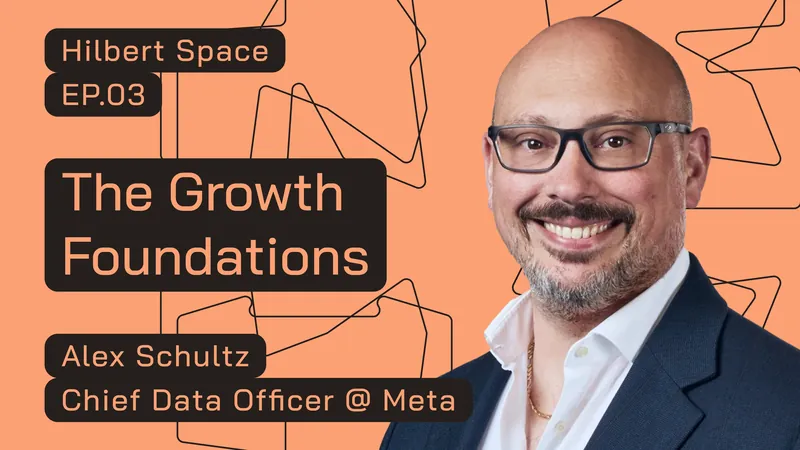
EP.03: The Growth Foundations
In this episode, we sit down with Alex Schultz, Chief Data Officer at Meta (and the person widely credited as the founder of the modern growth practice) to unpack what growth actually is, why most teams get measurement wrong, and how AI is rewriting the implementation of growth's timeless principles. Alex breaks down why growth has never really changed: it's about growing the active users of your product, full stop. We cover that the biggest failures don't come from picking the wrong metric, but from unexamined biases, accidental p-hacking, and top-down pressure to ship what the data says you shouldn't. The perfect metric matters far less than doing the analysis right.
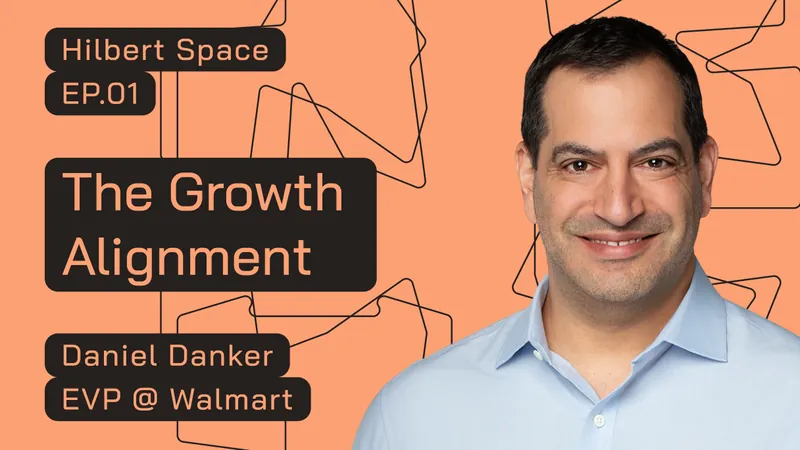
EP.01: The Growth Alignment
In this inaugural episode of Hilbert Space, we sit down with Daniel Danker, EVP of AI Acceleration, Product and Design at Walmart, to unpack why sustainable growth is more complex than it looks, and how AI is finally giving retailers the tools to get it right.

Hilbert Space EP.04: Building for Global Growth with Carles Reina, Baobab Ventures
In this episode, we sit down with Carles Reina, managing partner of Baobab Ventures and a key leader behind ElevenLabs’ global growth. We unpack what it actually takes to build and scale a company across markets, and how AI is changing the way teams think about GTM.