Hilbert Space EP.05: Growth for the Long Run with Stelleo Tolda, Mercado Libre
In this episode, we sit down with Stelleo Tolda, co-founder and board member of Mercado Libre. We talk about building a company that still runs in “continuous beta,” why AI should drive revenue growth and not just cut costs, and why the best growth decisions take conviction.
Stelleo Tolda, co-founder and board member of Mercado Libre, joins Hilbert’s Ceyda Erten and Gerard Espinet to talk about building the company from a 1999 idea at Stanford. He explains why Mercado Libre stays in “continuous beta,” why AI should drive revenue growth rather than only cut costs, and why investing with conviction pays off.
Key takeaways
- Early growth was a daily discipline: the team made sure it sold a little more every day than the day before, every week and every month, to prove the network had value.
- Mercado Libre innovates by assuming risk and executing with excellence, and measures everything at the most granular level to drive continuous improvement. It calls itself “continuous beta.”
- Using AI only to cut costs is a very limited approach. The bigger opportunity is to use it as a driver of revenue growth, new businesses and new ways of doing things.
- The harder obstacle is often leadership: board members and executives need to align with the technology and be willing to take risks, cannibalize themselves and try new things.
- Be willing to invest and to bet when you have clear conviction. Doubling down in Mexico paid off, while waiting to grow the tech team was a cost.
Chapters
- 00:00 Intro: AI as a driver of growth, not just efficiency
- 01:10 The idea behind Mercado Libre in 1999
- 03:22 Starting in Brazil and proving traction every day
- 04:43 Taking risks and executing with excellence
- 06:03 Customer service, NPS and measuring everything
- 08:55 Continuous beta and growth as a learning process
- 10:03 Why Stelleo stays close to Latin American founders
- 11:57 How AI differs from every platform shift before it
- 15:37 What companies are missing on AI
- 16:27 Aligning leadership with technology
- 20:18 Pointing competitiveness outward
- 22:34 Resilience and learning from mistakes
- 24:52 Why the opportunity is still ahead
- 26:28 The best growth decision: doubling down in Mexico
- 29:12 The regret: investing in tech talent earlier
About the guest
Stelleo Tolda is co-founder and board member of Mercado Libre. He and his co-founders were at business school at Stanford when they started the company in 1999. Three months after the launch in Argentina, he joined to start Brazil, which became the company’s largest market. Among the many hats he wore was responsibility for customer service. He recently joined the board of Endeavor Brazil.
“The use for this technology for a lot of companies is just thinking in terms of efficiency. So how can I reduce costs? Which is fine, that’s one approach, but I think it’s a very limited approach.” — Stelleo Tolda, Co-founder and Board Member at Mercado Libre
“We say that we are in continuous beta. … It’s always something that can improve, and that’s everything that we do.” — Stelleo Tolda, Co-founder and Board Member at Mercado Libre
“Be willing to invest, be willing to bet, especially when you have a clear conviction of when and how to do it.” — Stelleo Tolda, Co-founder and Board Member at Mercado Libre
Read the full episode summary
From Stanford to Latin America
Hilbert co-founder Ceyda Erten and Gerard Espinet, Hilbert’s founding GTM and ops lead, welcome Stelleo Tolda, co-founder and board member of Mercado Libre. Stelleo takes the story back to 1999 and the early internet revolution. He and his co-founders were at business school at Stanford, in the heart of Silicon Valley, and could see that technology was going to change people’s lives.
Looking at the business models around them, eBay’s stood out. In his view eBay was the quintessential internet company: a network where anyone could be a buyer or a seller. Amazon, by contrast, was then a store selling CDs, DVDs and books. His two Argentine co-founders started the company in Argentina, and three months later Stelleo joined them to start Brazil, which has since become the company’s largest market.
Proving traction every day
The most basic early challenge was convincing people to use a new technology at all. When he presented the idea to Latin American classmates, many were confused. The answer was to build the network and show traction. From the very early days the team lived by one rule: sell a little more every day than the day before, every week more than the prior week, every month more than the last. That trajectory showed the founders they were on track and showed users the platform had value.
Risk, execution and continuous beta
Asked what has kept Mercado Libre innovating, Stelleo names two ingredients. The first is risk: “We assume risks, that’s how we innovate,” and making bets is still in the company’s DNA. The second is executing with excellence, as operators who want to be better against themselves, against the competition and for their users.
He illustrates this with a story from when he was responsible for customer service. Seeing users’ frustration firsthand, the team built a dedicated intelligence group, separate from the team handling the daily inflow of contacts, to find where the friction was. They built NPS flows into almost everything and read what customers were saying, not just the numbers. Working closely with technology and product meant designers saw the effects of their work, for good and for bad, and went back to the drawing board when needed. Measuring everything at the most granular level became a key driver of continuous improvement. Mercado Libre still describes itself as being in “continuous beta.”
The hosts connect this to Hilbert’s view: no one can promise that doing X, Y and Z will make you grow, so growth is a learning process. Teams that test, measure and improve faster than anyone else are very hard to catch, but that also takes leadership and team transformation.
Staying close to founders
As a board member, Stelleo keeps challenging Mercado Libre to invest more and be better. He is also passionate about the entrepreneurial ecosystem in Latin America, starting with Brazil, where he is from, and extending to Argentina, Mexico, Chile and Colombia. The hosts note that he recently joined the board of Endeavor Brazil and that he took Hilbert, a company started in Istanbul and San Francisco, to Brazil first.
A platform shift unlike any other
In about 35 years as an operator, Stelleo has seen the internet, the mobile revolution, which Mercado Libre adapted to when not every company of its generation did, and the rise of cloud. AI, he says, is unlike all of them. If he were starting today, much would be different, including how the company is structured, and Mercado Libre is reflecting on exactly that. New founders and funds think globally from day one because language barriers have fallen and the problems they tackle are universal. He sees opportunities and threats, but calls it a great time to be an entrepreneur and an investor.
AI as a growth driver, not just a cost cutter
Asked what companies are missing about AI, Stelleo says many think only about efficiency and reducing costs. That is one approach, but a very limited one. Companies should ask how the technology can drive revenue growth, new businesses and new ways of doing things.
He sees a bigger obstacle in the boardroom: an asymmetry between what many board members know, and how they are used to doing business, and what the technology can do. The better companies will resolve that mismatch and gain an advantage by aligning their leadership with technology. Leadership is not always willing to take risks, cannibalize itself or try new things, so for companies like Hilbert, convincing people inside a company to adopt the technology can be harder than building it. He is also excited by companies that could not exist without AI, the way eBay could not have existed without the internet.
The hosts add that this is a leadership and transformation moment, where teams align on growing the company rather than only on their own KPIs, which is why Hilbert treats growth as a multidisciplinary problem.
Point competitiveness outward
Mercado Libre’s leadership recognized early that they were very competitive people, and learned to harness that energy outward rather than against each other. Even now, they still see risks and competitors around them; he compares it to playing in the Champions League. As the company grew, he learned to bring in talented people, give them opportunity and space, and get out of their way.
The story was not smooth. There were times when the company might not have continued and had to raise funds. Innovation means risk and uncertainty, so trial and error is part of the business. Things usually won’t work at first, and that is fine. What you can’t afford is to repeat the same mistakes.
The best growth decision, and the regret
Stelleo still feels the company is scratching the surface, with e-commerce penetration, digital financial services and purchase frequency per active user still low in its markets. His best growth decision came at a board meeting in Mexico, during a fierce battle with a competitor. Mercado Libre chose to double down on a multi-year investment cycle and, as a public company, told the market it might become unprofitable for a time. It turned out to be the right decision, and the company is now in another heavy investment cycle in Brazil.
His regret: although Mercado Libre saw itself as a technology company, it took a while to commit to growing its technology team. Deciding earlier could have put it on a growth path sooner. Both lessons point the same way: be willing to invest and to bet when you have clear conviction, because the cost of not doing so can be tremendous.
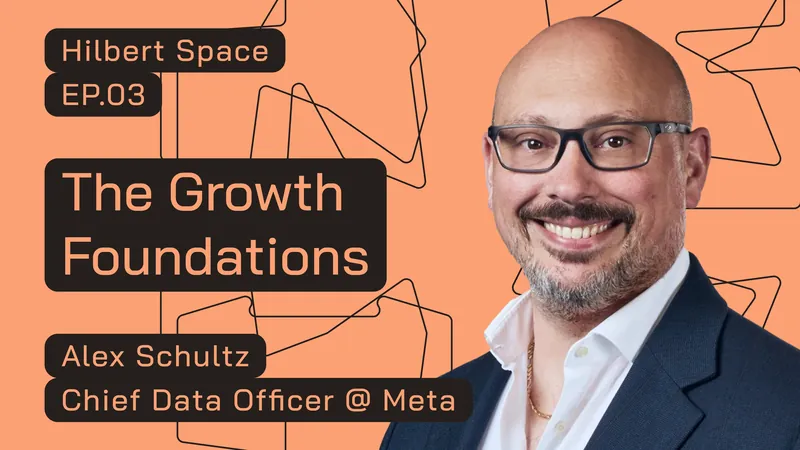
EP.03: The Growth Foundations
In this episode, we sit down with Alex Schultz, Chief Data Officer at Meta (and the person widely credited as the founder of the modern growth practice) to unpack what growth actually is, why most teams get measurement wrong, and how AI is rewriting the implementation of growth's timeless principles. Alex breaks down why growth has never really changed: it's about growing the active users of your product, full stop. We cover that the biggest failures don't come from picking the wrong metric, but from unexamined biases, accidental p-hacking, and top-down pressure to ship what the data says you shouldn't. The perfect metric matters far less than doing the analysis right.

Hilbert Space EP.04: Building for Global Growth with Carles Reina, Baobab Ventures
In this episode, we sit down with Carles Reina, managing partner of Baobab Ventures and a key leader behind ElevenLabs’ global growth. We unpack what it actually takes to build and scale a company across markets, and how AI is changing the way teams think about GTM.
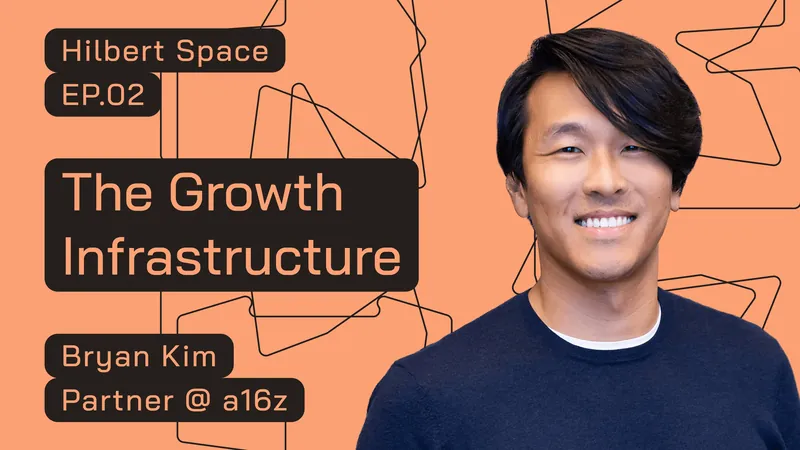
EP.02: The Growth Infrastructure
In this episode, we sit down with Bryan Kim, Partner at a16z, to dig into what growth actually costs when it goes wrong, and what it takes to build the infrastructure to get it right. Bryan spent over five years at a16z backing some of the most ambitious consumer businesses of this era, including ElevenLabs, Function Health, Mirage, Partiful. Before that, he built and ran growth at Snap (from 100 people and zero revenue to 4,000 people and $2B in revenue) and developed firsthand what it means to think about growth as a systems problem, not a metrics problem.